Graph Neural Networks in JAX
Because I really love using JAX I had to use it for my latest project involving GNNs. In PyTorch, you have many options to build your own GNNs, most notably PyTorch Geometric and Deep Graph Library. But the graph ecosystem is not as developed in JAX, which means that I had to implement my own models.
I ended up with two approaches: one using the adjacency matrix and one using the edge list.
Using the Adjacency Matrix
The adjacency formulation is pretty straightforward:
import equinox as eqx
import equinox.nn as nn
import jax.experimental.sparse as jsparse
from jax import vmap
from jaxtyping import Array, Float, Int, PRNGKeyArray


class GraphConv(eqx.Module):
    linear: nn.Linear

    def __init__(self, hidden_dim: int, *, key: PRNGKeyArray):
        self.linear = nn.Linear(hidden_dim, hidden_dim, key=key)

    def __call__(
        self,
        nodes: Float[Array, "n_nodes hidden_dim"],
        adjacency: Int[jsparse.BCOO, "n_nodes n_nodes"]
    ) -> Float[Array, "n_nodes hidden_dim"]:
        messages = vmap(self.linear)(nodes)
        return adjacency @ messages
The code should be easy to read. It does the following update:
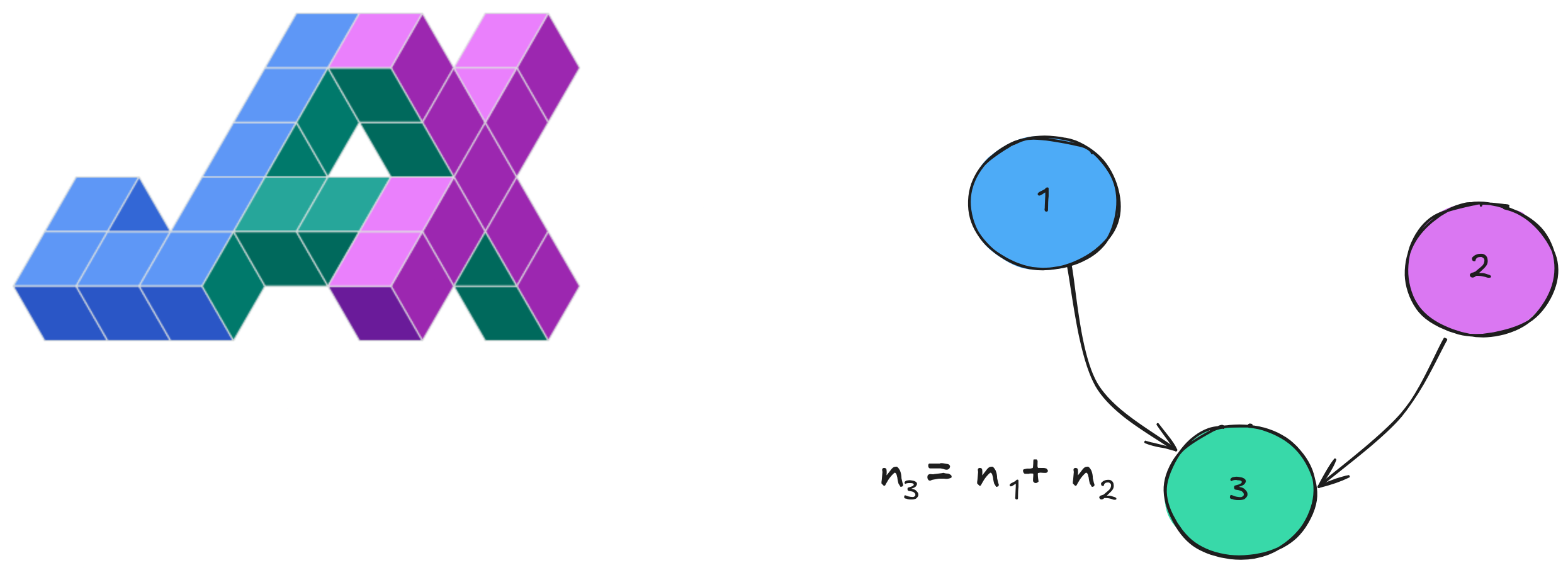
n_i \leftarrow \sum_{j \in \mathcal{N(i)}} W n_j
I used JAX's
sparse module
for efficiency, which is still experimental. The only thing to take care
about is how you define your adjacency matrix. In the code above I
consider that A[i, j] is 1 if an edge
j \rightarrow i exists. Implementing
the updates for the min or max aggregation
schemes looks a bit trickier. It is what motivated the use of the
(dirty?) edge list data structure.
Using the Edge List
This one took me a while for the first time. Everything clicked once I
found out about
jax.ops:
import equinox as eqx
import equinox.nn as nn
from jax import vmap
from jaxtyping import Array, Float, Int, PRNGKeyArray

class GraphConv(eqx.Module):
    linear: nn.Linear

    def __init__(self, hidden_dim: int, *, key: PRNGKeyArray):
        self.linear = nn.Linear(hidden_dim, hidden_dim, key=key)

    def __call__(
        self,
        nodes: Float[Array, "n_nodes hidden_dim"],
        edges: Int[Array, "n_edges 2"],
    ) -> Float[Array, "n_nodes hidden_dim"]:
        messages = vmap(self.linear)(nodes)
        messages = messages[edges[:, 0]]  # Shape of [n_edges hidden_dim].
        messages = jax.ops.segment_max(
            data=messages,
            segment_ids=edges[:, 1],
            num_segments=len(nodes),
        )  # Shape of [n_nodes hidden_dim].
        return messages
Here, I consider the edges as a list of tuples [j, i] for
every edge j \rightarrow i. This layer
applies a basic GNN update using the max aggregation operation:
n_i \leftarrow \max_{j \in \mathcal{N(i)}} W n_j
Using
jax.ops
is much harder to read when encountered for the first time but it
basically does exactly what we want. We give an array of values to which
we want to apply the aggregation operation and an array of indices. The
aggregation is then computed over the grouped values (segments) defined
by the indices.
Be careful of default values! If a node index is not
present in segment_ids, it will be filled with some default
value that depends on the aggregation used. For example,
jax.ops.segment_max will fill missing values with
-inf, which is probably not what you want!
Here's a general aggregation implementation that covers everything:
from functools import partial

import jax
import jax.numpy as jnp
from jaxtyping import Array, Float, Int

@partial(jax.jit, static_argnums=[2, 3, 4])
def aggregate(
    messages: Float[Array, "n_edges hidden_dim"],
    destination_index: Int[Array, " n_edges"],
    n_nodes: int,
    aggregation_type: str,
    default_value: float = 0.0,
) -> Float[Array, "n_nodes hidden_dim"]:
    match aggregation_type:
        case "sum":
            segment_fn = jax.ops.segment_sum
        case "mean":
            segment_fn = jax.ops.segment_sum
        case "min":
            segment_fn = jax.ops.segment_min
        case "max":
            segment_fn = jax.ops.segment_max
        case _:
            raise ValueError(f"Unknown aggregation type {aggregation_type}")

    messages = segment_fn(messages, segment_ids=destination_index, num_segments=n_nodes)

    ones = jnp.ones((len(destination_index), 1), dtype=jnp.int32)
    degrees = jax.ops.segment_sum(
        ones, segment_ids=destination_index, num_segments=n_nodes
    )

    if aggregation_type == "mean":
        messages = messages / degrees

    messages = jnp.where(degrees == 0, default_value, messages)
    return messages
This code does not use equinox so you should be able to use
it with any JAX framework.
JIT'ing Graphs
Of course you will need to JIT your computations. JAX's JIT is shape-dependent so you have to make sure all of your graphs have the same shape to avoid frequent recompilations. Padding on graphs can be done with a fake node and fake edges going to that node. Don't forget to pad both the nodes and edges. You will need to add fake edges to the sparse matrix as well! JIT's cache relies on the number of elements in the sparse matrix.
It would be too verbose to show the implementation here but feel free to have a look at my repo.
Final Thoughts
I was quite surprised to see that no simple JAX GNN implementation can be found online. The main library for manipulating GNNs seems to be jraph but it is unmaintained and pretty hard to understand.
I really like the control that JAX gives to the developer and it will always be more fun to implement my own models myself. I know I can rely on JAX's core operations that are efficiently compiled.